The Watchtower Society (officially incorporated as the Watch Tower Bible and Tract Society of Pennsylvania) is the main legal and corporate entity used by Jehovah’s Witnesses to direct, produce, and distribute their religious literature worldwide. Founded in 1881 by Charles Taze Russell in Pittsburgh, Pennsylvania, it was initially established as the Zion’s Watch Tower Tract Society to publish religious tracts and the magazine now known as The Watchtower.
Throughout its history, the Society has served as the administrative core of the movement. Under its second president, Joseph Franklin Rutherford, the organization centralized its leadership, standardized doctrines, and officially adopted the name “Jehovah’s Witnesses” in 1931 to distinguish the group from other Bible Student factions that had split off after Russell’s death. The Watchtower Society became the vehicle through which all door-to-door preaching materials, translations (including their New World Translation of the Holy Scriptures), and organizational guidelines were published and disseminated globally.
While members of the public often use “the Watchtower” interchangeably with Jehovah’s Witnesses as a religious group, within the organization there is a operational distinction. The legal corporations—including the Pennsylvania entity and the Watchtower Bible and Tract Society of New York, Inc.—are non-profit legal instruments managed under the direction of the Governing Body, a small council of elder men based at the group’s global headquarters in Warwick, New York, who oversee the spiritual doctrines and worldwide activities of the faith.
Most Jehovah’s Witnesses use the term “Watchtower Society” or just “The Society” when they think of both the people and the place where their publications and other materials originate. (This includes books, booklets, tracts, videos, website, meeting programs, and other materials.)
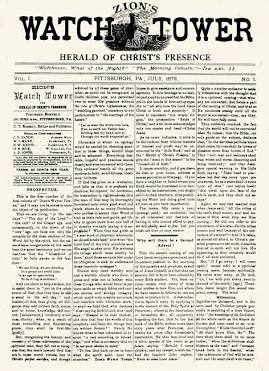
“The Watchtower” can, of course, also refer to their primary publication, a magazine that is most widely known for presenting the teachings of Jehovah’s Witnesses. This primary journal (published by the Watch Tower Bible and Tract Society) has undergone five title revisions since its inception in 1879. These adjustments reflected shifts in focus, doctrinal emphasis, and corporate branding over the decades.
| July 1, 1879 | Zion’s Watch Tower and Herald of Christ’s Presence | Founded by Charles Taze Russell as an 8-page monthly publication. The title emphasized the movement’s focus on biblical prophecy and the belief in Christ’s unseen spiritual presence. |
| January 1, 1909 | The Watch Tower and Herald of Christ’s Presence | The word “Zion’s” was dropped, and “The” was added. This change coincided with the relocation of the organization’s headquarters from Allegheny (Pittsburgh), Pennsylvania, to Brooklyn, New York. |
| October 15, 1931 | The Watchtower and Herald of Christ’s Presence | A subtle stylistic change: “Watch Tower” (two words) was combined into a single word, “Watchtower”. This was done shortly after the group adopted the official name Jehovah’s Witnesses at a convention in Columbus, Ohio, in July 1931 |
| January 1, 1939 | The Watchtower and Herald of Christ’s Kingdom | The phrase “Christ’s Presence” was replaced with “Christ’s Kingdom”. Under the leadership of second president Joseph F. Rutherford, the editorial scope shifted toward emphasizing Christ as an actively ruling heavenly King. |
| March 1, 1939 | The Watchtower Announcing Jehovah’s Kingdom | Just two months later, the title was changed to “The Watchtower Announcing Jehovah’s Kingdom”. This final rephrasing put primary emphasis on God’s personal name (Jehovah) and his sovereign rule. It remains the official subtitle to this day. |
A lesser-known use of the term “Watchtower Society”
“Watchtower Society” can also refer specifically to the pool of 300 to 500 select, active male members who hold voting shares in the Watch Tower Bible and Tract Society of Pennsylvania to satisfy corporate and legal requirements. These designated members attend annual corporate meetings and cast votes to elect the board of directors, functioning purely as a legal mechanism rather than a democratic governing body for the global religion. To fulfill the corporate charter and bylaws, the organization maintains a restricted membership roster limited to between 300 and 500 “mature, active, and faithful” male Jehovah’s Witnesses.
The JW.ORG website https://wol.jw.org/en/wol/d/r1/lp-e/1101993018 says the following:
Hence, at the business meeting of all shareholder-voters of the Society on October 2, 1944, it was unanimously voted that the Society’s charter be revised and be brought into closer harmony with theocratic principles. Membership would not now be unlimited as to number but would be between 300 and 500, all of whom would be men chosen by the board of directors, not on the basis of monetary contributions, but because they were mature, active, faithful Witnesses of Jehovah who were serving full-time in the work of the organization or were active ministers of congregations of Jehovah’s Witnesses. These members would vote for the board of directors, and the board of directors would then select its officers. These new arrangements went into effect the following year, on October 1, 1945.
Note that at the bottom of this site’s Home Page, you can find some highlights of the Watchtower Society’s organization (and doctrinal) history in a timeline format.